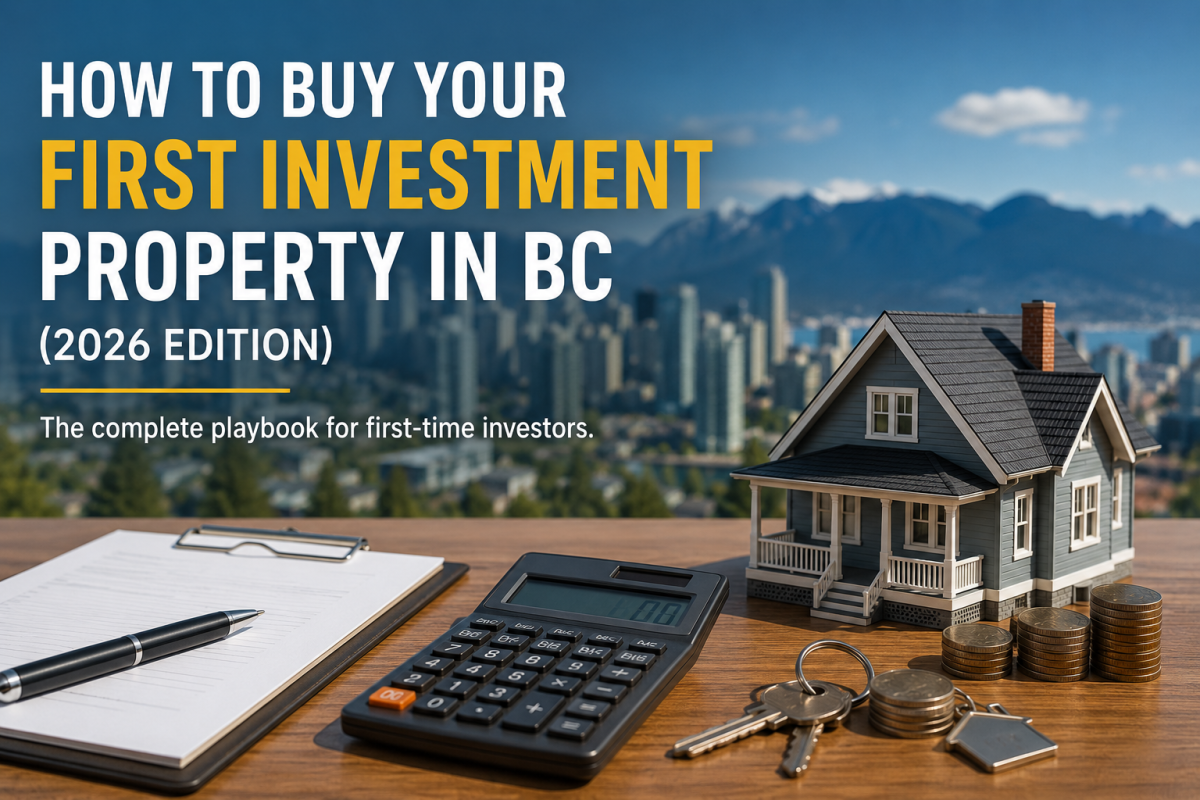
How to Buy Your First Investment Property in BC (2026 Edition): The Complete Beginner's Guide
Buying your first investment property is one of the smartest ways to build long-term wealth—but success starts long before you make an offer.
British Columbia remains one of Canada's most desirable real estate markets. While higher interest rates and stricter lending rules have changed the landscape, opportunities still exist for investors who buy strategically.
Whether you're planning to purchase a rental condo, townhouse, or duplex, this guide explains exactly how to buy your first investment property in BC in 2026.
Why Invest in BC Real Estate?
Real estate continues to offer three major wealth-building advantages:
-
Long-term property appreciation
-
Monthly rental income
-
Mortgage principal paid down by tenants
Unlike stocks, investment properties allow investors to use leverage—meaning they can control a valuable asset while investing only a portion of the purchase price.
For many Canadians, buying a rental property becomes the foundation of long-term financial security.
Step 1: Understand the 20% Down Payment Rule
One of the biggest surprises for first-time investors is the required down payment.
Unlike purchasing your primary residence, most investment properties require a minimum 20% down payment.
Because the property is intended to generate rental income rather than serve as your primary home, mortgage default insurance generally isn't available for standard investment purchases.
For example:
| Purchase Price | Minimum Down Payment |
|---|---|
| $600,000 | $120,000 |
| $750,000 | $150,000 |
| $900,000 | $180,000 |
In addition to the down payment, buyers should budget for:
-
Closing costs
-
Property transfer tax (where applicable)
-
Legal fees
-
Home inspection
-
Appraisal fees
-
Initial repairs or maintenance
-
Emergency reserve fund
Tip: Avoid using all your savings for the down payment. Keeping a financial cushion helps protect you against vacancies and unexpected repairs.
Step 2: Use Rental Income to Increase Your Buying Power
Many first-time investors don't realize that future rental income can help them qualify for a mortgage.
Most lenders will consider approximately 50% of the property's expected rental income, while some lenders may use higher percentages depending on the property and your financial profile.
This is commonly known as a rental income offset.
Example
Purchase Price: $700,000
Expected Monthly Rent: $2,600
50% Rental Offset:
$1,300/month
That additional qualifying income can significantly improve your borrowing capacity. A mortgage broker experienced with investment properties can help determine which lender offers the most favourable rental income calculations.
Step 3: Choose the Right Investment Property
Not every property makes a good investment.
Look for homes that combine strong rental demand with long-term appreciation potential.
Key factors include:
-
Walking distance to SkyTrain stations
-
Low vacancy neighbourhoods
-
Growing employment centres
-
Nearby universities
-
Hospitals
-
Shopping and restaurants
-
Future infrastructure investment
In Metro Vancouver, transit-oriented communities often maintain stronger resale value and attract consistent rental demand.
Step 4: Calculate Positive Cash Flow
A common mistake is focusing only on appreciation.
Successful investors also analyze monthly cash flow.
Estimate:
-
Mortgage payment
-
Property taxes
-
Strata fees
-
Insurance
-
Maintenance
-
Vacancy allowance
-
Property management (if applicable)
Then compare those expenses against expected rental income.
Even if a property breaks even today, future rent increases and mortgage paydown can improve returns over time.
Step 5: Get Pre-Approved Before Shopping
Obtaining mortgage pre-approval helps you:
-
Know your maximum budget
-
Lock in an interest rate (when available)
-
Strengthen your offer
-
Move quickly in competitive markets
Your lender will review:
-
Income
-
Employment
-
Credit score
-
Existing debts
-
Down payment
-
Rental income projections
Having financing ready gives sellers greater confidence in your offer.
Step 6: Buy in Areas With Long-Term Growth
The best investors purchase based on future potential—not just today's prices.
Some of BC's strongest-performing investment areas continue to be neighbourhoods experiencing:
-
New SkyTrain expansion
-
Major employment growth
-
University expansion
-
New hospitals
-
Large mixed-use developments
-
Transit-oriented communities
These factors often increase both rental demand and future resale value.
Common Mistakes First-Time Investors Make
Avoid these costly errors:
-
Buying based only on emotions
-
Ignoring monthly carrying costs
-
Underestimating maintenance expenses
-
Choosing poor locations
-
Not researching strata documents
-
Overleveraging finances
-
Forgetting vacancy risks
Real estate should be evaluated as a long-term investment—not a short-term speculation.
Should You Buy a Condo or Townhouse?
Condos
Pros
-
Lower purchase price
-
Easier maintenance
-
Strong rental demand
-
Popular with first-time investors
Cons
-
Monthly strata fees
-
Strata bylaws
-
Smaller living spaces
Townhouses
Pros
-
Family-friendly
-
Higher resale demand
-
Larger living areas
-
More stable long-term tenants
Cons
-
Higher purchase price
-
Higher maintenance responsibilities
The right choice depends on your investment goals, budget, and target tenant profile.
Investment Property Checklist
Before making an offer, ask yourself:
- Do I have at least a 20% down payment?
- Have I been pre-approved?
- Does the property generate strong rental demand?
- Have I reviewed the strata documents?
- Is the neighbourhood growing?
- Can I comfortably manage vacancies or unexpected repairs?
- Does the property fit my long-term financial goals?
If the answer is yes to all of these, you're in a strong position to move forward.
Final Thoughts
Buying your first investment property can feel overwhelming, but every experienced investor starts with a single purchase.
By understanding financing rules, planning for the required down payment, using rental income to strengthen your mortgage application, and focusing on high-demand locations, you can build a real estate portfolio that generates income and long-term wealth.
Working with an experienced REALTOR® and mortgage professional can help you identify investment opportunities, evaluate potential returns, and avoid costly mistakes along the way.
The best investment property isn't necessarily the cheapest—it's the one that aligns with your financial goals and performs well over time.
Frequently Asked Questions
Everything you need to know about this topic. Can't find the answer you're looking for? Reach out to our team.
Most lenders require a minimum 20% down payment for a traditional investment property, plus funds for closing costs, legal fees, inspections, and an emergency reserve.
Yes. Many lenders use around 50% of the expected rental income—and some may use more, depending on the lender and your financial profile—to help determine your borrowing capacity.
For investors with a long-term strategy, desirable locations, and sound financial planning, BC real estate can continue to provide rental income, mortgage paydown, and potential appreciation over time.
Many first-time investors begin with a condo because of its lower purchase price and strong rental demand. Townhouses can also be attractive for those targeting families and longer-term tenants.